Noted composer and one of the original founding co-directors of the Center, Milton Babbitt passed away on Saturday January 29th, 2011, at the age of 94. A full obituary is available on the New York Times web site at this link. Besides his influence and accomplishments generally as a composer, Babbitt was the composer who worked most closely with the RCA Mark II synthesizer at the Center, drawn to the equipment by its ability to precisely specify musical parameters, particularly rhythms.
A fascinating clip of Babbitt discussing his experiences working with the RCA Mark II is available on YouTube, at this link. It appears to be drawn from the online resource "The Video Archive of the Electroacoustic Music", curated by composer Eric Chasalow and Barbara Cassidy. Their site includes more interviews (it requires Apple Quicktime to view).
WKCR radio is broadcasting a 24-hour memorial marathon of Babbitt's music, beginning tonight (January 31) at 1am (so, actually early in the morning of February 1) and ending at 1am early Wednesday (February 2). Tune in to their broadcast, or online stream, to hear some of this influential composer's many works.
R.I.P. Milton Babbitt
Showing posts with label Milton Babbitt. Show all posts
Monday, January 31, 2011
Wednesday, December 17, 2008
Babbitt correspondence, Composers Forum recordings - some progress
Now that the valiant Angela Perez has been assisting with the processing work, we've finished putting most of the Babbitt correspondence in folders, and will begin work on the finding aid for this material soon. We'll provide detail to the folder level for this correspondence, but more general description for the other materials in the collection (such as administrative records, equipment manuals, etc.).
On a separate note, we're hoping that we may focus on a sub-section of the recordings, the Composers Forum concert recordings, on reel-to-reel tapes. The Composers Forum was established in 1935, with funding from the WPA, to present the work of American composers. It was active initially in New York; when the WPA ended, it continued briefly in San Francisco under private patronage, went on hiatus during the war, and then was revived under the joint sponsorship of the New York Public Library and Columbia University in 1947.

The reel-to-reel tapes in the archives here represent recordings from this later phase of the Composers Forum. The Electronic Music Center's involvement here appears to have been to record the concerts, which were held at several locations around New York. Most if not all of the works appear to be acoustic, rather than electronic, works. Pril Smiley, a former director of the Center, described to me hauling a large Ampex reel-to-reel recorder and mic to Midtown to record a concert (and these machines weighed a ton!).
There is an existing card file index to this material, which is arranged by composer. If transferred to electronic format, it would allow people to also search to see what the contents of a particular reel is, or to browse the recordings chronologically, for example. This is one concrete step towards improved access that we hope to undertake soon, since the necessary preservation work is a more long-term proposition.
A significant feature of the Composers Forum concerts was the inclusion of a discussion period, where composers would discuss their works. This aspect appears to be well-represented on the reels in this collection, with many labeled to indicate "discussion" or "comments". Besides the obvious value of the musical works recorded on the tapes, we think that the discussion material will be of value and interest to researchers interested in American art music from this period.
On a separate note, we're hoping that we may focus on a sub-section of the recordings, the Composers Forum concert recordings, on reel-to-reel tapes. The Composers Forum was established in 1935, with funding from the WPA, to present the work of American composers. It was active initially in New York; when the WPA ended, it continued briefly in San Francisco under private patronage, went on hiatus during the war, and then was revived under the joint sponsorship of the New York Public Library and Columbia University in 1947.

The reel-to-reel tapes in the archives here represent recordings from this later phase of the Composers Forum. The Electronic Music Center's involvement here appears to have been to record the concerts, which were held at several locations around New York. Most if not all of the works appear to be acoustic, rather than electronic, works. Pril Smiley, a former director of the Center, described to me hauling a large Ampex reel-to-reel recorder and mic to Midtown to record a concert (and these machines weighed a ton!).
There is an existing card file index to this material, which is arranged by composer. If transferred to electronic format, it would allow people to also search to see what the contents of a particular reel is, or to browse the recordings chronologically, for example. This is one concrete step towards improved access that we hope to undertake soon, since the necessary preservation work is a more long-term proposition.
A significant feature of the Composers Forum concerts was the inclusion of a discussion period, where composers would discuss their works. This aspect appears to be well-represented on the reels in this collection, with many labeled to indicate "discussion" or "comments". Besides the obvious value of the musical works recorded on the tapes, we think that the discussion material will be of value and interest to researchers interested in American art music from this period.
Labels:
Composers Forum,
correspondence,
Milton Babbitt,
recordings
Saturday, July 5, 2008
More compostional techniques?
As we've seen with tape splicing, some compositional processes in electronic music in the early days of the Center were time-consuming and painstaking. Unlike today, when audible feedback on compositional choices can be almost instantaneous, much planning would often need to go into the generation of electronic sound.

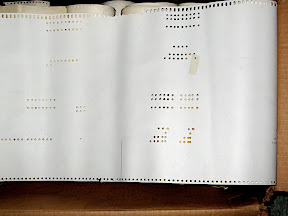
Many punched paper rolls are found in the archives, apparently used to generate sounds on the RCA sysnthesizer. The edges of the paper rolls are perforated, and holes were punched in the paper to generate sound.

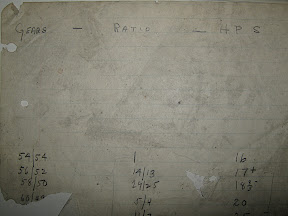
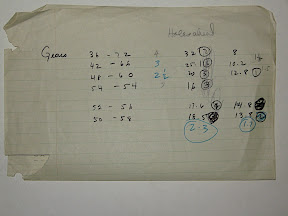
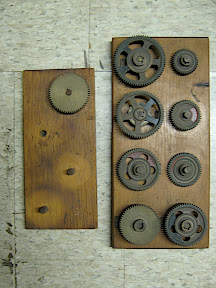
Scattered throughout many of Babbitt's papers and sketches are references to "holes", "ratios", and "gears".

I hope to gain some more insight into these terms by speaking to the Associate Director of the Center. I'm speculating that perhaps "holes" refers to the holes punched in the paper rolls, and that the calculations had to do with tempo. I'm still not sure how "gears" and "ratios" fit in, but it would be interesting to determine if they have any connection to the fractional notations found in some Babbitt scores and sketches.
And, just how might this fit into things!?
Many punched paper rolls are found in the archives, apparently used to generate sounds on the RCA sysnthesizer. The edges of the paper rolls are perforated, and holes were punched in the paper to generate sound.
Scattered throughout many of Babbitt's papers and sketches are references to "holes", "ratios", and "gears".
I hope to gain some more insight into these terms by speaking to the Associate Director of the Center. I'm speculating that perhaps "holes" refers to the holes punched in the paper rolls, and that the calculations had to do with tempo. I'm still not sure how "gears" and "ratios" fit in, but it would be interesting to determine if they have any connection to the fractional notations found in some Babbitt scores and sketches.
And, just how might this fit into things!?
Sunday, June 15, 2008
Now, things get interesting...
My latest work in the archives has yielded some really interesting items. Along with the predictable administrative records such as financial statements and requisitions, there has been a parade of interesting items, led by sections of music manuscript by the prominent American composer Milton Babbitt. There are what appear to be sketches or drafts of portions of at least two works, "Phonemena" and "Occasional Variations".
Here's a detail of one of the scores. Many pages include numerical annotations, that may perhaps refer to serial or other compositional processes.

Here is what could be a compositional matrix of some kind, perhaps associated with "Occasional Variations" (this sketch was contained in an envelope with music manuscript sketches, marked with this title).
Here's a detail of one of the scores. Many pages include numerical annotations, that may perhaps refer to serial or other compositional processes.

Here is what could be a compositional matrix of some kind, perhaps associated with "Occasional Variations" (this sketch was contained in an envelope with music manuscript sketches, marked with this title).
Subscribe to:
Posts (Atom)