 The BBC has an interesting story up on their web site, which describes what is said to be the earliest recording of music by a computer. An amusing audio clip, beginning with a computer rendition of "God save the Queen", is included. The recording was generated by the Ferranti Mark I, called the "... first commercially available general purpose computer".
Sunday, August 3, 2008
BBC story highlights "earliest" computer music
The BBC has an interesting story up on their web site, which describes what is said to be the earliest recording of music by a computer. An amusing audio clip, beginning with a computer rendition of "God save the Queen", is included. The recording was generated by the Ferranti Mark I, called the "... first commercially available general purpose computer".


Friday, July 25, 2008
Audio survey tool
I'm currently using an audio survey tool, developed by the Preservation Division of the Columbia University Libraries, to conduct a survey of a controlled sample of the recordings in the collection. A similar tool is also offered by the Sound Directions project at Harvard.
As can be seen from many of the images that I've been posting on the blog, the recordings in this collection are in poor environmental conditions, and are showing signs of damage. I'm hoping that the data generated by this survey will provide some baseline data for advocating for future preservation. I will survey a 350-item sample from the total of 5,569 recordings.
The survey tool is built on an Access database, and it is designed for use by non-specialists in recording media. It features many drop-down menus in fields that enable quick and consistent data entry. That said, it also contains many fields that can capture advanced technical details of the items being surveyed. The accompanying manual is clear and detailed, and I've found it easy to use.
However, there were a few hurdles. Firstly, it's Windows only. I use a Mac laptop, so my options were to get Windows up and running on my Mac (by using something like Parallels Desktop), or, to gather the data needed by hand, and then input the data when I had access to a Windows machine. I chose the latter.
In practice, I have a feeling that gathering data by hand may be easier and quicker for most people, but, your mileage may vary. Since surveying the materials often means clambering into hard-to-reach corners and upper shelves, I wouldn't want to be running back and forth, and the space I'm working in doesn't have a comfortable place to sit down with a laptop!
So, my solution was to mock up a paper sheet with the important fields, following the order given on the program's input form, and then use abbreviated codes to gather data by hand on the sheet on a clip-board. I know, not very high-tech! If you wanted to be more space-age, you could perhaps try to get the program up and running on a hand-held PDA or something.
All in all, it seems like quite a useful tool. I've learned some new things about audio formats, and the various forms of damage you might find, such as "cupping", "windowing", and "non-library wind" (if you really want to know, you can find some detailed imaged in this document).
I'll be posting the results of the survey here, as it is completed.
As can be seen from many of the images that I've been posting on the blog, the recordings in this collection are in poor environmental conditions, and are showing signs of damage. I'm hoping that the data generated by this survey will provide some baseline data for advocating for future preservation. I will survey a 350-item sample from the total of 5,569 recordings.
The survey tool is built on an Access database, and it is designed for use by non-specialists in recording media. It features many drop-down menus in fields that enable quick and consistent data entry. That said, it also contains many fields that can capture advanced technical details of the items being surveyed. The accompanying manual is clear and detailed, and I've found it easy to use.
However, there were a few hurdles. Firstly, it's Windows only. I use a Mac laptop, so my options were to get Windows up and running on my Mac (by using something like Parallels Desktop), or, to gather the data needed by hand, and then input the data when I had access to a Windows machine. I chose the latter.
In practice, I have a feeling that gathering data by hand may be easier and quicker for most people, but, your mileage may vary. Since surveying the materials often means clambering into hard-to-reach corners and upper shelves, I wouldn't want to be running back and forth, and the space I'm working in doesn't have a comfortable place to sit down with a laptop!
So, my solution was to mock up a paper sheet with the important fields, following the order given on the program's input form, and then use abbreviated codes to gather data by hand on the sheet on a clip-board. I know, not very high-tech! If you wanted to be more space-age, you could perhaps try to get the program up and running on a hand-held PDA or something.
All in all, it seems like quite a useful tool. I've learned some new things about audio formats, and the various forms of damage you might find, such as "cupping", "windowing", and "non-library wind" (if you really want to know, you can find some detailed imaged in this document).
I'll be posting the results of the survey here, as it is completed.
Thursday, July 10, 2008
Some statitstics from the collection
OK, I've arrived at some summary numbers for the collection:
Recordings:
2,682 7" reels 141.16 linear feet
2,177 10.5" reels 145.13 linear feet
4,859 Total tape reels 286.29 linear feet
73 CDs+CDRs
430 DATs
16 Records, 16"
100 Records, 12"
3 Records, 10"
8 Records, 7"
6 Cassettes
1 Beta PCM
6 Mini-discs
15 VHS tapes
42 Mini-DV cassettes
Total documents and manuscripts 72.5 linear feet
137 sub-total, music scores (printed, ozalid, manuscript)
98 sub-total, punched paper rolls (RCA synthesizer)
Recordings:
2,682 7" reels 141.16 linear feet
2,177 10.5" reels 145.13 linear feet
4,859 Total tape reels 286.29 linear feet
73 CDs+CDRs
430 DATs
16 Records, 16"
100 Records, 12"
3 Records, 10"
8 Records, 7"
6 Cassettes
1 Beta PCM
6 Mini-discs
15 VHS tapes
42 Mini-DV cassettes
Total documents and manuscripts 72.5 linear feet
137 sub-total, music scores (printed, ozalid, manuscript)
98 sub-total, punched paper rolls (RCA synthesizer)
Saturday, July 5, 2008
More compostional techniques?
As we've seen with tape splicing, some compositional processes in electronic music in the early days of the Center were time-consuming and painstaking. Unlike today, when audible feedback on compositional choices can be almost instantaneous, much planning would often need to go into the generation of electronic sound.
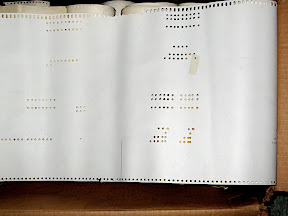
Many punched paper rolls are found in the archives, apparently used to generate sounds on the RCA sysnthesizer. The edges of the paper rolls are perforated, and holes were punched in the paper to generate sound.
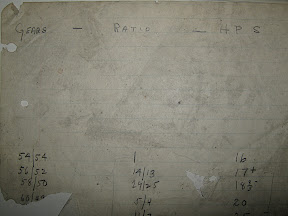
Scattered throughout many of Babbitt's papers and sketches are references to "holes", "ratios", and "gears".
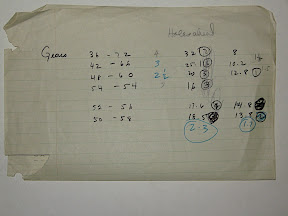
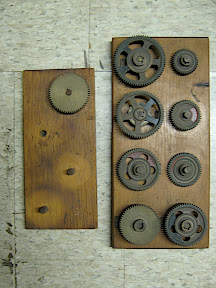
I hope to gain some more insight into these terms by speaking to the Associate Director of the Center. I'm speculating that perhaps "holes" refers to the holes punched in the paper rolls, and that the calculations had to do with tempo. I'm still not sure how "gears" and "ratios" fit in, but it would be interesting to determine if they have any connection to the fractional notations found in some Babbitt scores and sketches.
And, just how might this fit into things!?
Many punched paper rolls are found in the archives, apparently used to generate sounds on the RCA sysnthesizer. The edges of the paper rolls are perforated, and holes were punched in the paper to generate sound.
Scattered throughout many of Babbitt's papers and sketches are references to "holes", "ratios", and "gears".
I hope to gain some more insight into these terms by speaking to the Associate Director of the Center. I'm speculating that perhaps "holes" refers to the holes punched in the paper rolls, and that the calculations had to do with tempo. I'm still not sure how "gears" and "ratios" fit in, but it would be interesting to determine if they have any connection to the fractional notations found in some Babbitt scores and sketches.
And, just how might this fit into things!?
Saturday, June 28, 2008
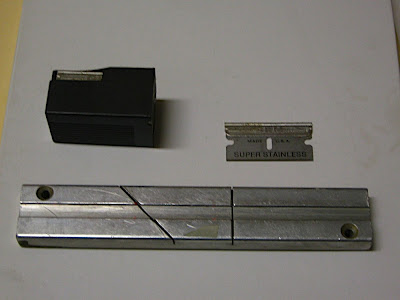
Some tools of the trade
Otto Luening and Vladimir Ussachevsky pioneered the use of the tape recorder as a compositional tool, and many composers to follow spent hours working over tape splicing blocks, razors and china markers in hand.
One box in the archives contains a collection of individual loops made by Ussachevsky.
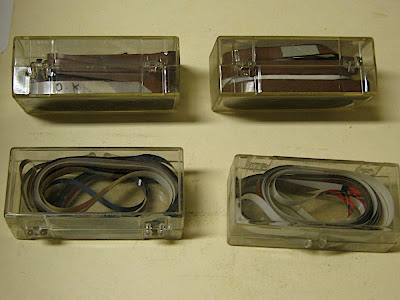
Some are marked with china marker, sometimes to indicate pitch.
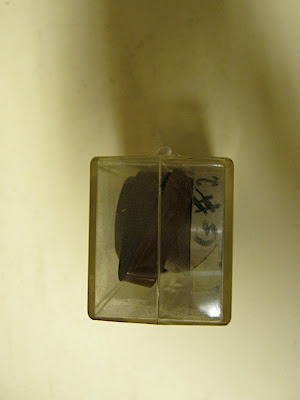
One box in the archives contains a collection of individual loops made by Ussachevsky.
Some are marked with china marker, sometimes to indicate pitch.
Thursday, June 26, 2008
Vinyl included
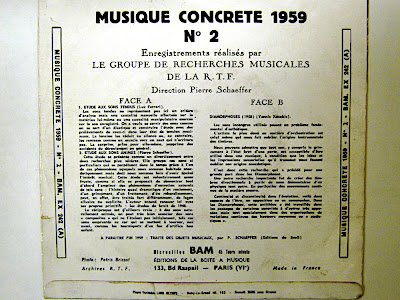
Contained in the archives are a handful of 7" vinyl records. Here is one which features compositions by Pierre Schaeffer, Iannis Xenakis, and Luc Ferrari (showing front and back of sleeve):
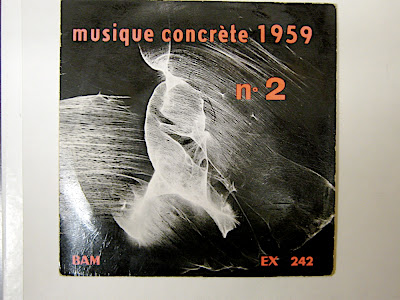
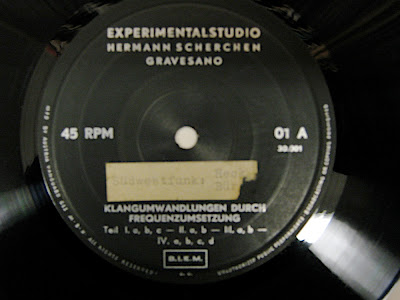
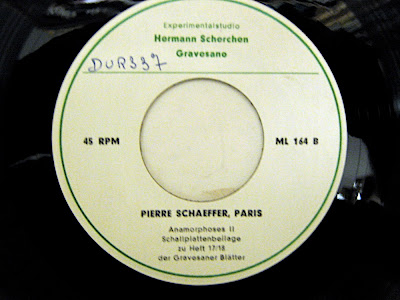
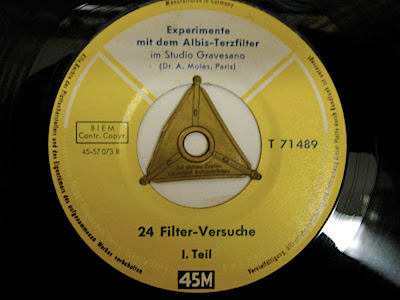
The collection contains a few others, which were apparently issued as accompanying material to numbers of the "Gravesaner Blatter", a periodical focused on experimental and electronic music. Here are examples of a few discs published by Hermann Scherchen's "Experimentalstudio Gravesano" in Switzerland, covering techincal processes of electronic music, works by Pierre Schaeffer, and examples of filter experiments:
Unfortunately, some of the discs are showing signs of warping, or in one case, chipping.
The collection contains a few others, which were apparently issued as accompanying material to numbers of the "Gravesaner Blatter", a periodical focused on experimental and electronic music. Here are examples of a few discs published by Hermann Scherchen's "Experimentalstudio Gravesano" in Switzerland, covering techincal processes of electronic music, works by Pierre Schaeffer, and examples of filter experiments:
Unfortunately, some of the discs are showing signs of warping, or in one case, chipping.
Sunday, June 15, 2008
Now, things get interesting...
My latest work in the archives has yielded some really interesting items. Along with the predictable administrative records such as financial statements and requisitions, there has been a parade of interesting items, led by sections of music manuscript by the prominent American composer Milton Babbitt. There are what appear to be sketches or drafts of portions of at least two works, "Phonemena" and "Occasional Variations".

Here's a detail of one of the scores. Many pages include numerical annotations, that may perhaps refer to serial or other compositional processes.

Here is what could be a compositional matrix of some kind, perhaps associated with "Occasional Variations" (this sketch was contained in an envelope with music manuscript sketches, marked with this title).


Here's a detail of one of the scores. Many pages include numerical annotations, that may perhaps refer to serial or other compositional processes.

Here is what could be a compositional matrix of some kind, perhaps associated with "Occasional Variations" (this sketch was contained in an envelope with music manuscript sketches, marked with this title).

Subscribe to:
Posts (Atom)

 Posts
Posts

